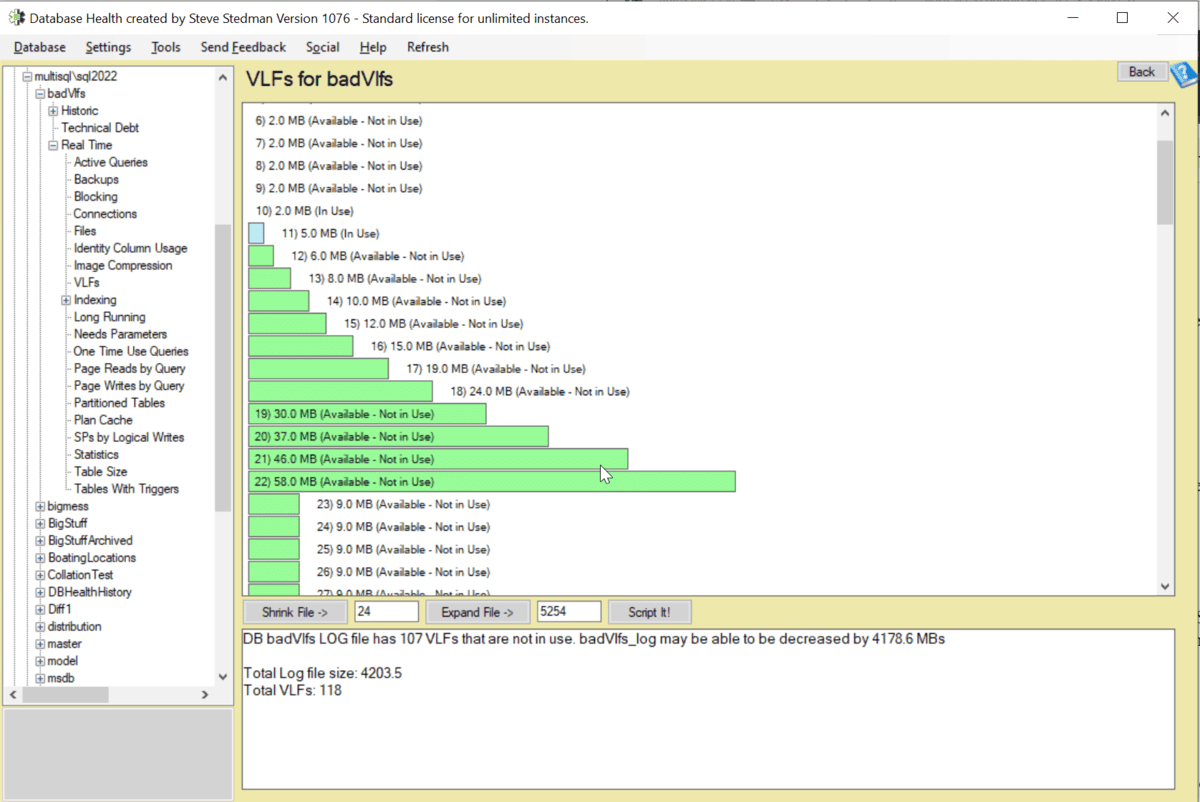
If you find your self asking what a VLF in SQL Server is, then this is the article for you. In SQL Server, a Virtual Log File (VLF) is a smaller segment within the transaction log file that allows SQL Server to manage its log space more efficiently. Understanding VLFs and their impact on database performance is essential for database administrators, as an excessive number of VLFs can lead to degraded performance during database recovery, backups, or general operations. With …

What Is a VLF in SQL Server? Read more »

Why My SQL Server Is Slow If you’re wondering, “Why my SQL Server is slow?”, you’re not alone. SQL Server performance issues can disrupt critical business operations, delay projects, and frustrate users. A slow SQL Server often points to underlying issues that can be diagnosed and resolved with the right approach. In this blog post, we’ll dive into common reasons why your SQL Server is slow, provide an in-depth look at each cause, and share practical steps to identify and …

Why my SQL Server is Slow? Read more »

Query to Check Compatibility Level in SQL Server Upgrading SQL Server to a newer version, such as SQL Server 2019 or 2022, requires verifying and updating the compatibility levels of your databases. Compatibility levels control database behaviors and enable certain SQL Server features, making them a crucial part of your upgrade process. In this guide, we’ll explore how to check compatibility levels, update them, and automate the process for multiple databases. We’ll also cover the compatibility level for SQL Server …

Query to Check Compatibility Level SQL Server Read more »

If you’ve ever encountered the “SQL Server Recovering” message for a database, you may have wondered what it means and whether it signals a problem. This message is part of SQL Server’s built-in safety mechanisms to ensure data integrity. While it’s not always a cause for alarm, understanding why it happens and how to handle it can save you significant time and effort. In this blog, we’ll delve into what “SQL Server Recovering” means, why it occurs, and the best …

SQL Server Recovering Read more »

Understanding and Resolving SQL Server Error 18456: Login Failed for User SQL Server Error 18456 is a common login error that can cause headaches for database administrators and developers alike. The error message typically appears as: “Login failed for user ‘<user_name>’. Reason: <reason>. Error: 18456.” This error occurs when a user attempts to connect to SQL Server and the authentication process fails. In this post, we’ll explore the common causes of this error, how to troubleshoot it, and best practices …

SQL Server Error 18456: Login Failed for User Read more »

How and When to Shrink SQL Server Log Files: Best Practices Explained Managing SQL Server log files is a common challenge for database administrators and developers. While shrinking transaction log files might seem like a quick fix for reclaiming disk space, there are key factors to consider before hitting that shrink button. What’s Covered in This Article: The Purpose of SQL Server Log Files Transaction log files are essential for maintaining data integrity and supporting recovery operations. They track every …

Shrink SQL Server Log Files: Best Practices Explained Read more »

Celebrate Small Business Saturday with 50% Off Our SQL Server Replication Course! Small Business Saturday is here, and to celebrate, we’re offering 50% off our SQL Server Replication course—but only for one day! Whether you’re managing databases in a small business or a larger enterprise, SQL Server replication is a crucial skill that can help ensure data availability, improve performance, and enhance disaster recovery. What Is SQL Server Replication? SQL Server Replication is a powerful method for distributing data across …

Saturday Sale: 50% Off SQL Server Replication Course! Read more »

= 2 THEN a.used_pages ELSE 0 END) * 8 AS IndexSpaceKBFROM sys.tables tINNER JOIN sys.partitions p ON t.object_id = p.object_idINNER JOIN sys.allocation_units a ON p.partition_id = a.container_idGROUP BY t.nameORDER BY TotalSpaceKB DESC; What the Query Does This query calculates: TotalSpaceKB: The total space allocated for each table, including data, indexes, and unused space. UsedSpaceKB: The space actively used by data and indexes. UnusedSpaceKB: The difference between the allocated space and the used space, representing room for growth. DataSpaceKB: The size …

Table Sizes in SQL Server – options Read more »

The Importance of a SQL Server Performance Assessment by Stedman Solutions Maintaining your SQL Server’s performance is essential in today’s fast-paced, data-driven world. At Stedman Solutions, we understand how critical your SQL Server is to your business’s success. That’s why we offer comprehensive performance assessments tailored to your environment. It all begins with a free 30-minute consultation to explore how we can address your unique SQL Server challenges and goals. Keeping Your SQL Server in Prime Condition A properly maintained …

Stedman SQL Server Performance Assessment Read more »

Understanding SQL Server Trace Flag 1118: Enhancing TempDB Performance When it comes to SQL Server Performance tuning, understanding and using trace flags can provide significant benefits. One particularly valuable trace flag is 1118, which can address contention issues in the TempDB database and improve performance in environments with heavy TempDB usage. Let’s dive into what Trace Flag 1118 does, when to use it, and how it can make a difference. What Does Trace Flag 1118 Do? Trace flag 1118 is …

Trace Flag 1118 Read more »